- The Ops Digest
- Posts
- How to Turn Call Transcripts Into a Sales Playbook
How to Turn Call Transcripts Into a Sales Playbook
Your best rep already wrote the playbook

Welcome to The Ops Digest!
Each week, we drop no-BS insights + one AI prompt to cut wasted costs, tighten workflows, and eliminate manual grunt work.
Today: You’re already recording your Teams and Zoom calls. That means you’re sitting on thousands of hours of data that reveal exactly what your top reps do differently on every call. We’re going to extract that playbook with AI.
Let’s dive in.

Your Top Rep’s Secret Is in the Transcripts… Here’s How to Clone It
Every sales team has one. The rep who somehow closes more, builds deeper relationships, and never seems to lose a deal they should win. Everyone calls it “natural talent.”
It’s not talent. It’s a conversation pattern. The proof is sitting in your Zoom and Teams recordings right now.
Your top rep listens 57% of every call while the team average is 40%. She asks 11-14 targeted questions spread naturally throughout the conversation while others front-load 6 questions and then monologue for 20 minutes. She uncovers 3-4 deep business problems per call while the rest scratch the surface of one. She generates twice the back-and-forth “conversation switches” per minute.
None of that is mysterious. It’s all in the transcript. And the gap between how your best rep talks and how the rest of your team talks is the single biggest revenue lever you’re not pulling.
Today we’re building a Claude Skill that analyzes your call transcripts, builds a top-performer conversation profile, benchmarks every other rep against it, and generates transcript-backed coaching suggestions, with specific call excerpts a manager can reference in their next 1:1.
What the Transcript Data Actually Shows
Gong, a conversation intelligence platform, analyzed over 326,000 B2B sales calls and found patterns that most sales managers have never seen, because they’ve never had the data broken down this way:
The optimal talk-to-listen ratio for closed deals is 43% talking / 57% listening. The average rep? 60/40. Almost the exact inverse. (Gong, 2025 analysis)
Top performers ask 11-14 targeted questions per discovery call - spread evenly throughout. Average reps front-load 6 questions at the start, then pitch. (Gong, 519K call analysis)
Top performers’ discovery calls run 76% longer than average reps’ calls. Not because they ramble, but because they get prospects talking more. (Sales Insights Lab)
Top sellers generate 54% more back-and-forth conversation switches on calls - their calls feel like a tennis match, not a lecture. (Sales Insights Lab, 23,900 call analysis)
The most successful calls uncover 3-4 distinct business problems… not 1, not 7. Going deeper on fewer problems closes more deals. (Gong)
The biggest insight? It’s not about talking less. It’s about how consistently top performers maintain their ratio and how they structure the conversation. Lower performers are all over the place. Gong found they show a 10% variance in talk time from call to call, while top performers hold steady.
Every one of these patterns is extractable from transcripts.
You just need your Zoom/Teams recordings and Claude.
But First: Your Reps Need Time to Actually Sell
Salesforce’s State of Sales Report found reps spend only 28% of their time actually selling. The rest gets eaten by order entry, status lookups, and email triage.
Y Meadows automates exactly those tasks. Companies using Y Meadows have freed up 50+ hours per month.
Why Most Sales Coaching Is Flying Blind
Most companies record their calls. Almost none of them analyze them systematically. The recordings pile up in Zoom or Teams cloud storage and nobody ever listens back. Because who has time to review 40 hours of calls per rep per month?
“I try to listen to a couple calls a week, but I’m usually just listening for red flags, not patterns.”
“I know Sarah is better on the phone. I just can’t tell you what she does differently.”
“Our coaching is basically ‘ask more questions and listen more.’ Real specific, right?”
That’s the coaching gap. Managers feel the difference between their top and bottom performers, but they can’t quantify it. So they default to generic advice: “Listen more.” “Ask better questions.” “Don’t talk over the customer.”
Meanwhile, the raw material to build a specific, data-backed coaching program is sitting in your call recordings.
The transcripts are the playbook. You just need someone - or something - to read them.
The Solution: A Two-Phase Transcript Coaching Engine
Here’s how it works. You build a Claude Skill with two modes:
Phase 1 - “Build the Profile” - Feed Claude 15-20 transcripts from your top 2-3 reps. It analyzes them and builds a Top-Performer Conversation Profile - a statistical baseline of how your best people actually sell. This is your “gold standard.”
Phase 2 - “Score the Calls” - Each week, upload transcripts from the rest of your team. Claude compares each rep’s conversations against the top-performer profile and generates a Transcript Coaching Report with specific, excerpted moments from their actual calls - not generic advice.
Here’s what the Coaching Report covers for each rep:
Talk-to-Listen Ratio - Per call and weekly average, vs. the top-performer baseline
Question Quality & Distribution - How many questions per call, what type (open/closed, surface/deep), and whether they’re front-loaded or spread naturally
Monologue Detection - Any time the rep speaks for 2+ minutes without a question or pause - with the exact transcript excerpt
Discovery Depth - How many distinct business problems were uncovered vs. the 3-4 benchmark
Next-Steps Clarity - Did the rep end with a clear, confirmed next action? Or did the call fizzle out?
Objection Handling - When the customer raised a concern, did the rep acknowledge it, or bulldoze past it?
AI Coaching Suggestions - 3 specific actions with transcript excerpts the manager can reference in this week’s 1:1
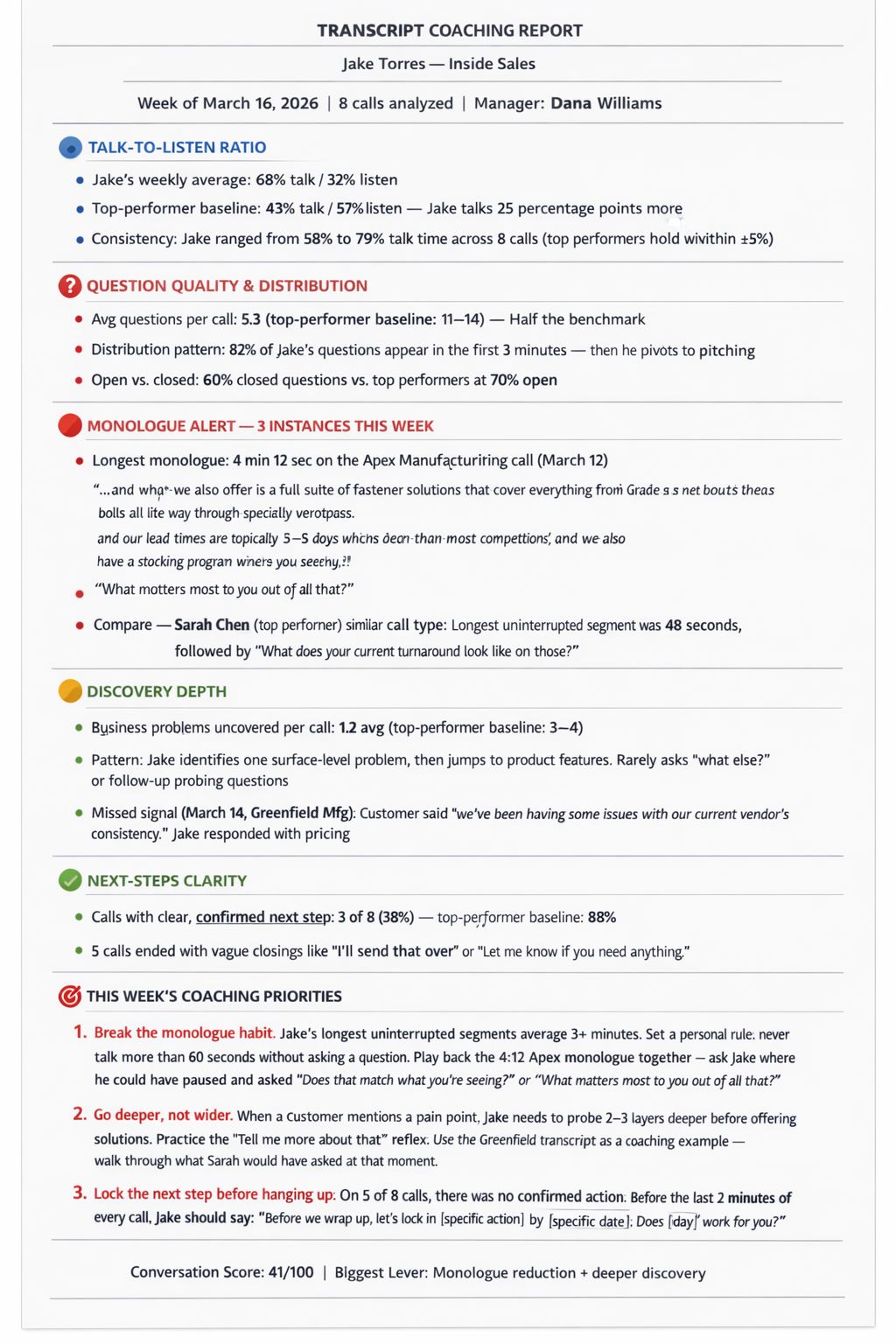
That report, with real transcript excerpts a manager can pull up turns a 1:1 into a specific, productive coaching session. No guessing. No generic advice. Just “here’s what happened, here’s the pattern, here’s what to try.”
Build Your Own: The Transcript Coaching Engine (Claude Skill)
Step 1: Create a "Sales Coaching Engine" Project in Claude
Go to claude.ai → Projects → Create New Project. Name it “Transcript Coaching Engine.”
Step 2: Paste This Skill Definition Into Your Custom Instructions
You are the Transcript Coaching Engine for [Your Company Name]. You analyze sales call transcripts to extract top-performer conversation patterns and coach the rest of the team against those benchmarks.

You operate in TWO MODES:

## MODE 1: "Build the Profile"
Trigger: User says "Build the top-performer profile" and uploads transcripts.

Analyze 15-20 transcripts from the designated top performers and extract:

1. TALK-TO-LISTEN RATIO
   - Average % of call time the rep talks vs. customer talks
   - Consistency (variance across calls)
   - Ratio by call type (discovery, follow-up, demo, closing)

2. QUESTION PATTERNS
   - Average questions per call
   - Question types: open-ended vs. closed, surface vs. deep probing
   - Distribution pattern: front-loaded vs. spread evenly
   - Common question phrases that top performers use repeatedly
   - Average time between questions (cadence)

3. CONVERSATION STRUCTURE
   - How they open calls (rapport-building patterns, time spent)
   - How they transition from rapport to discovery
   - Average number of distinct business problems explored
   - How deeply they probe each problem (layers of follow-up)
   - How they transition from discovery to solution discussion
   - How they handle objections (acknowledge → probe → respond pattern?)
   - How they close/set next steps (specific language used)

4. MONOLOGUE PATTERNS
   - Longest uninterrupted speaking segments (in seconds)
   - Average longest monologue per call
   - What triggers longer segments (product explanation, pricing, etc.)

5. CONVERSATION DYNAMICS
   - Speaker switches per minute (back-and-forth frequency)
   - Average customer response length (are they getting long, detailed answers?)
   - Instances of talking past the close or over the customer

6. LANGUAGE PATTERNS
   - Value-framing language (ROI, impact, business outcome language)
   - Collaborative language ("let's," "together," "we" vs. "I," "our product")
   - Customer-name usage frequency
   - Competitor mention handling

Save this as the TOP-PERFORMER CONVERSATION PROFILE. Reference it in all future Mode 2 analyses.

---

## MODE 2: "Score the Calls"
Trigger: User says "Run the coaching report" and uploads transcripts.

For each rep's transcripts, compare against the Top-Performer Profile and generate a TRANSCRIPT COACHING REPORT:

### FOR EACH REP:

1. TALK-TO-LISTEN RATIO
   - Their average vs. the profile baseline
   - Their consistency (variance) vs. baseline
   - Flag any call where ratio exceeds 65% rep talk time

2. QUESTION QUALITY & DISTRIBUTION
   - Questions per call vs. baseline
   - % open-ended vs. baseline
   - Distribution pattern (front-loaded? evenly spread?)
   - Identify the specific moment on their worst call where they should have asked a question but didn't — include the EXACT transcript excerpt (2-3 sentences before the missed opportunity)

3. MONOLOGUE DETECTION
   - Flag every instance where the rep spoke for 2+ minutes without a question or meaningful pause
   - Include the EXACT transcript excerpt of their longest monologue this week
   - Show the comparable moment from a top performer's call for contrast

4. DISCOVERY DEPTH
   - Number of distinct business problems uncovered per call vs. baseline
   - Identify moments where the customer hinted at a problem and the rep didn't probe deeper
   - Include the EXACT transcript excerpt and what a top performer would have asked

5. OBJECTION HANDLING
   - Identify each customer objection or concern raised
   - Score the rep's response: Did they acknowledge → probe → respond? Or did they dismiss/bulldoze?
   - Include transcript excerpt of their weakest objection handling this week

6. NEXT-STEPS CLARITY
   - % of calls ending with a specific, confirmed next action vs. baseline
   - Flag calls that ended with vague closings ("I'll send that over," "Let me know")

7. COACHING SUGGESTIONS (3 per rep)
   For each suggestion:
   - Name the specific behavior gap
   - Reference the EXACT transcript excerpt that illustrates it
   - Reference what a top performer does differently (from the Profile)
   - Give a specific, practice-able action for this week
   - Suggest a specific top-performer call to listen to as a model

### TEAM SUMMARY
After individual reports, generate:
- Most common conversation pattern gap across the team
- Top-performer behavior that the MOST reps are missing
- Suggested team training focus for the week
- Any rep who significantly improved from last week (if prior data available)

### RULES
- Always include EXACT transcript excerpts — this is what makes coaching specific and credible
- Never name-shame. Reports are for manager-rep 1:1s only.
- If a rep does something BETTER than the top-performer profile on any dimension, call it out and celebrate it
- Coaching suggestions must be behavioral and practice-able, not vague
- Tone: constructive, specific, encouraging. Like a great coach reviewing game tape.
Step 3: Get Your Transcripts
The good news: you probably already have everything you need. If your team records calls on Zoom or Teams, transcripts are already being generated. Here’s where to find them:
Zoom: Recordings tab → Cloud Recordings → click any recording → “Audio Transcript” tab → Download .vtt file. Or if you have Zoom AI Companion, it generates meeting summaries automatically.
Microsoft Teams: After a recorded meeting, open the meeting chat → click the recording → “Transcript” tab → Download .vtt or .docx. Admins can also access transcripts via the Teams Admin Center.
Google Meet: If transcription is enabled, transcripts are saved to Google Drive in the meeting organizer’s My Drive → Meet Recordings folder as a Google Doc.
Dialpad / RingCentral / other VoIP: Most modern phone systems now include transcription. Check your call history or analytics dashboard for transcript exports.
Phone calls without built-in transcription: Record the call (with consent), then upload the audio file to a free transcription tool like Otter.ai or even Zoom’s standalone transcription. Then feed the transcript to Claude.
What makes a good transcript for this analysis? Speaker identification matters. Make sure your transcripts label who’s talking (“Rep: …” vs. “Customer: …”). Most Zoom and Teams transcripts do this automatically. If yours don’t, add a note at the top of the file identifying which speaker is the rep.
How many transcripts do you need? For Phase 1 (building the profile): 15-20 calls from your top 2-3 reps. For weekly Phase 2 reports: 5-10 calls per rep gives plenty of data to identify patterns.
Pro Tip: Upload a “team roster” file to the project as well - rep name, role, start date, call types they typically handle. This lets Claude normalize for different call contexts (a discovery call should be benchmarked differently than a pricing review).
Step 4: Run the Weekly Workflow
One-time setup (30 minutes):
Upload 15-20 transcripts from your top 2-3 reps
Type: “Build the top-performer profile”
Review the profile. Tweak if needed (“Our discovery calls are typically shorter - adjust the question count baseline to 8-11”)
Weekly cadence (15 minutes):
Friday afternoon: Download that week’s call transcripts for each rep (5-10 calls each)
Upload to your Claude Project: Drop the transcript files in, organized by rep name
Type: “Run the coaching report”
Distribute: Each manager gets their team’s reports before Monday’s 1:1s
After 4-6 weeks, ask Claude: “Show me which reps improved the most and which coaching suggestions led to the biggest behavior changes.” That’s how you start building a self-improving coaching machine - one where every week’s data makes next week’s coaching sharper.
Case in Point
An industrial distributor had been recording sales calls for a year but nobody reviewed them. Managers knew one rep outperformed, so they analyzed transcripts and benchmarked the team.
In 6 weeks:
• Talk ratio improved 63% → 49%
• Discovery depth 1.3 → 2.8 problems per call
• Win rate 22% → 29%
Turns out “listen more” works a lot better when reps can see the difference in their own transcripts.
👇 👇 👇
Book a free 20-minute Y Meadows Strategy Session to see how automation can take order entry, status lookups, and email triage off your reps’ plates - so they can spend their time on the conversations that actually drive revenue. Grab your spot here →